Business case, plan, budget and timesheets in one control system, so status comes from evidence rather than optimism.
Early access. Teams are invited progressively.

Not because anyone is lying. By the time a report is wrong enough to notice, the money is spent.
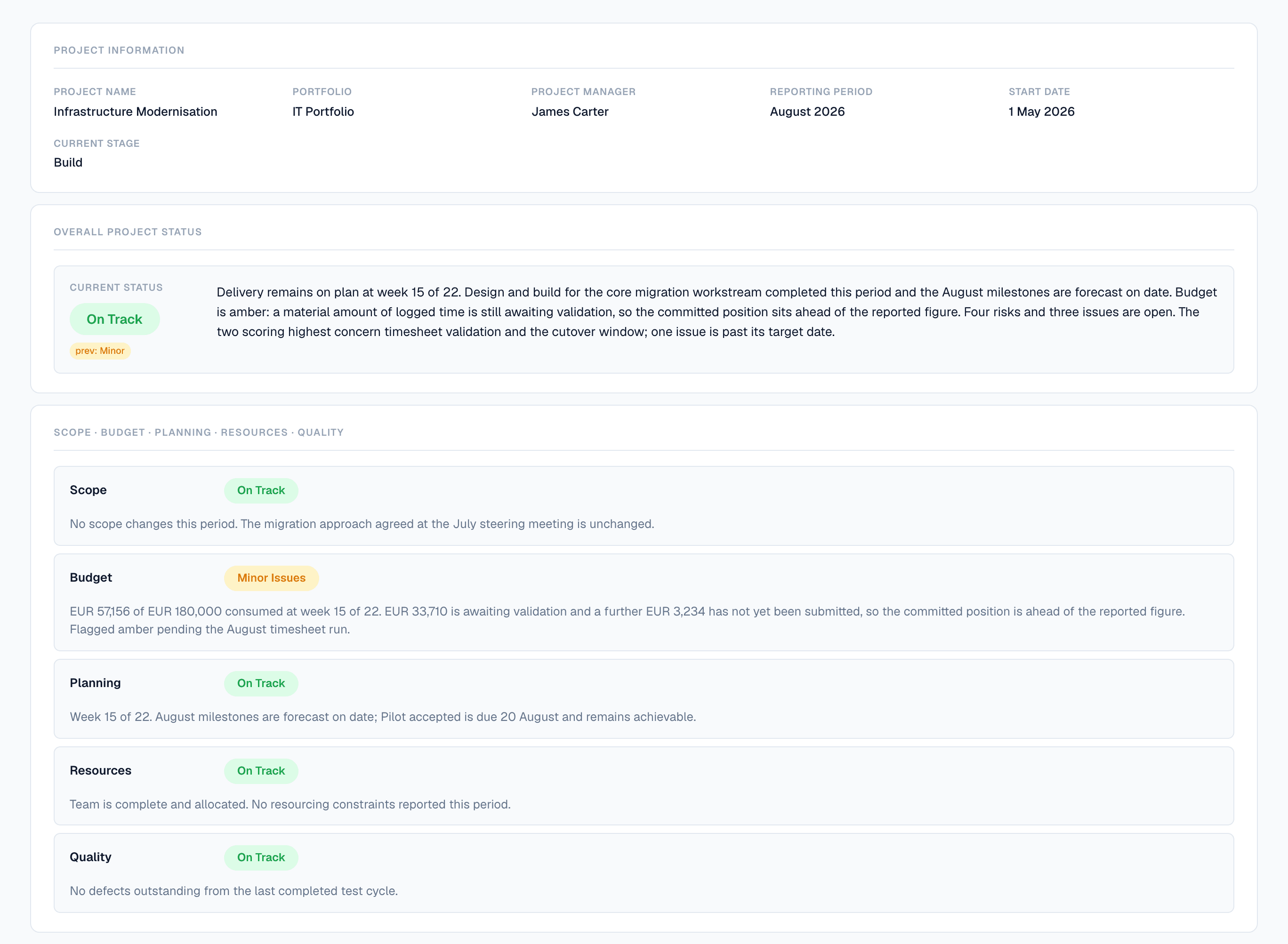
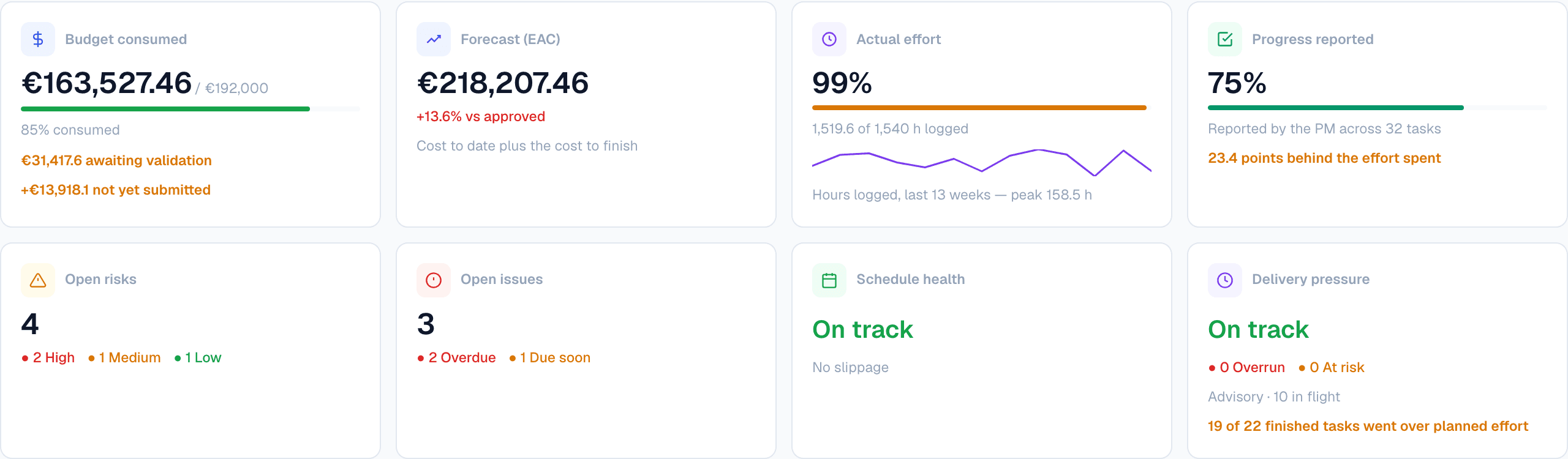
Flowr watches the gap between what a project reports and what its own data says.
A diagram, not a screen. Flowr makes this comparison continuously and tells you which side of your threshold a project has landed on. It does not draw the curve.
A task can be 60% finished and have used 90% of its hours. Flowr notices, and tells you which tasks. What you do about it is your call.
Submitting a week counts its hours as actual cost. You are not waiting on an approval queue to find out what a project has spent. Approving it records who checked and never moves the total.
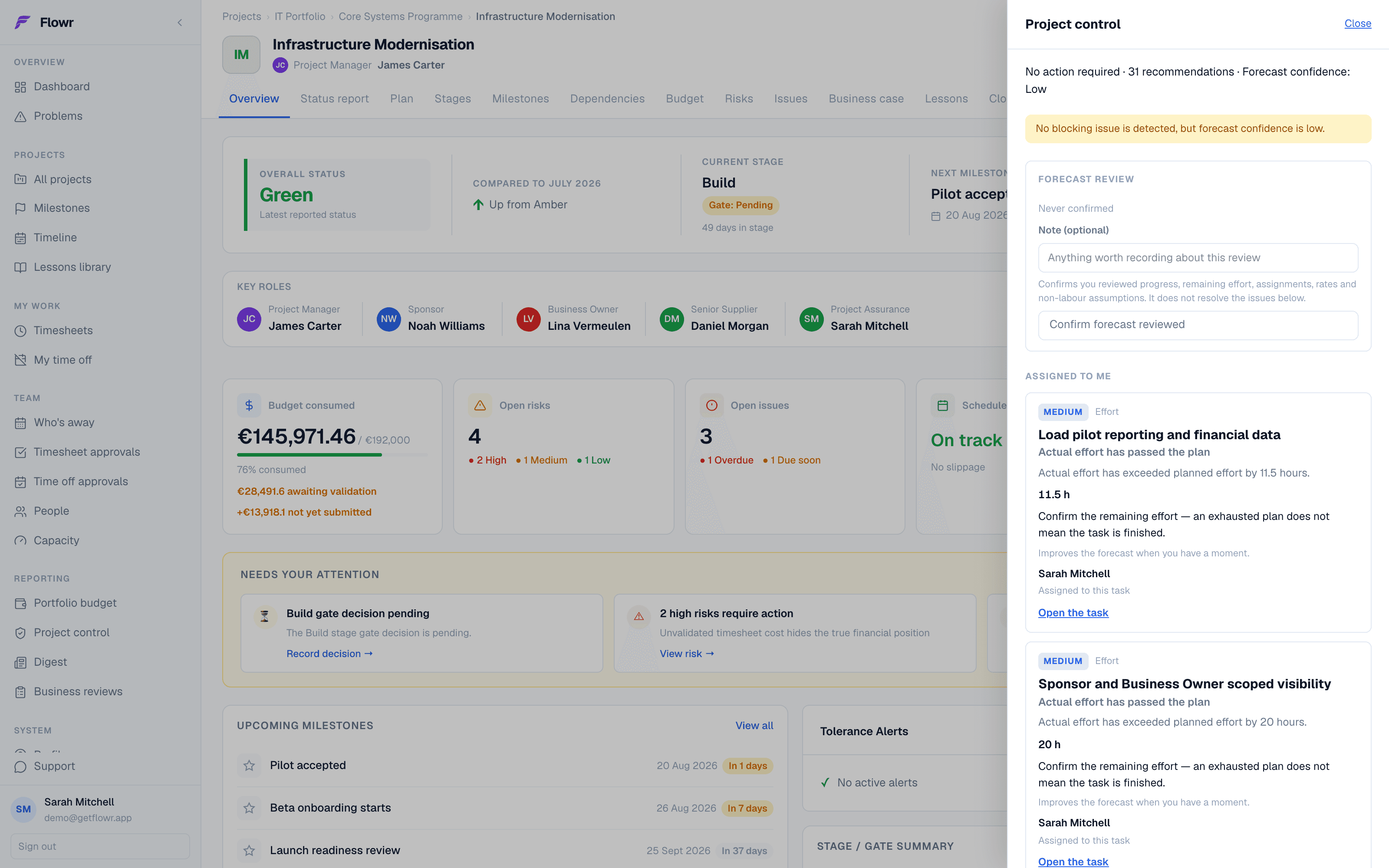
When Flowr flags something, you either say why it is fine or you fix it. Either way your answer is on the record, and the flag stays until you give one.
Every flag comes with the numbers behind it: which task, how many hours, how big the gap. You can check it yourself before you act on it.

Set the rule at organisation level. Flowr applies it to everything, without anyone having to remember.
How much overrun, how many days of slippage, before green stops being green.
Define your stages once, and have them applied to every new project. Which of them need a gate before work continues is part of the template.
Every project records who is sponsor, business owner, assurance. Fifteen PRINCE2 and PMI roles ship with Flowr, and you can add your own if your organisation names them differently.
Naming someone assurance on a project lets them see it. It does not let them edit, approve or administer anything. That stays with their access role.

What Flowr covers, from the business case through to closure. The stages a project runs through are your own. You set the list, and which of them need a gate before work continues.

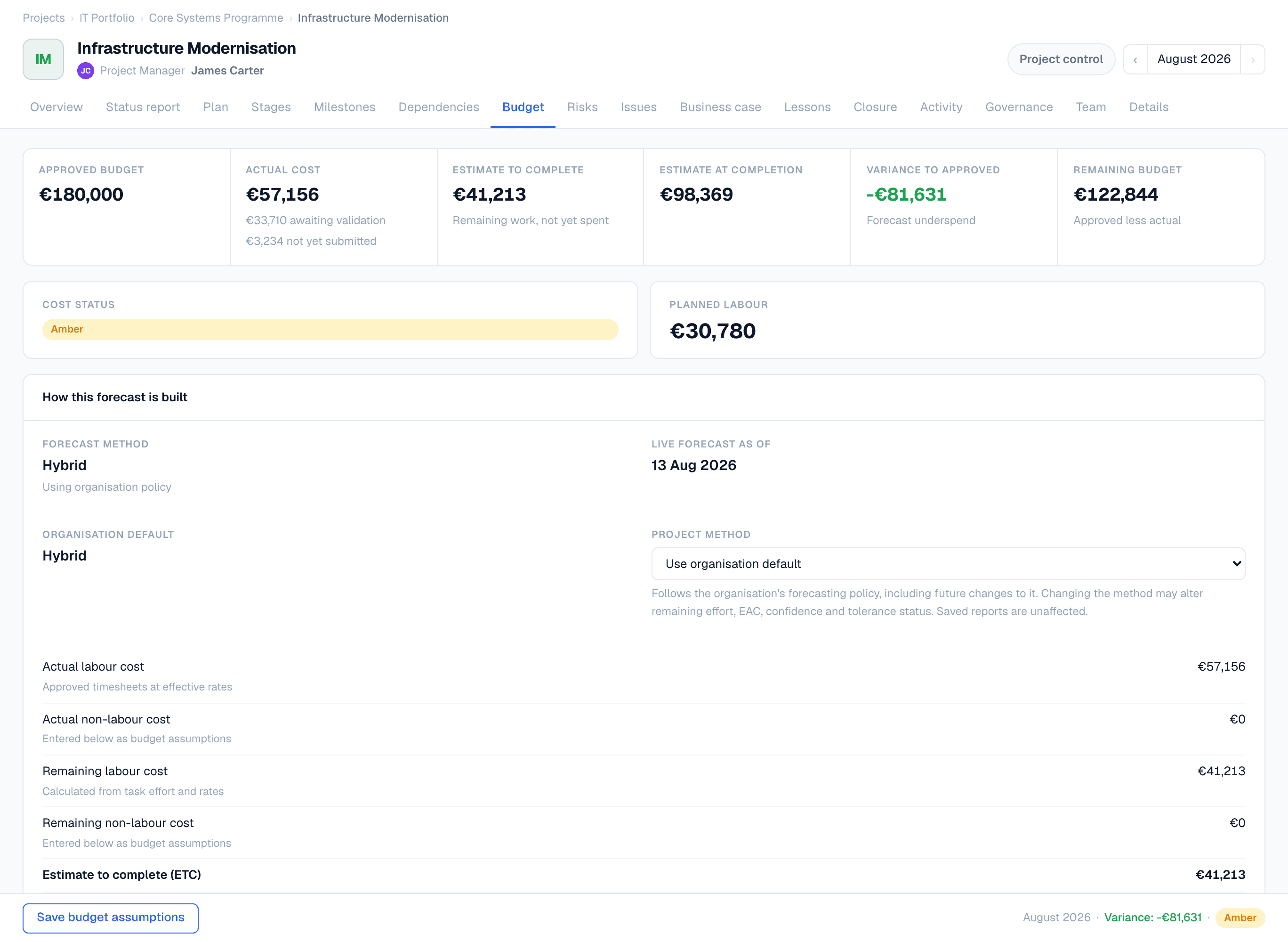
The cost is calculated from the timesheets and the rates in force when the work was done. The budget it’s measured against is a record of who approved what, and when. Neither is a number somebody typed to make the total work.


Over the plan and over the budget are different problems. Flowr reports both, so an increase somebody authorised does not read as an overrun.
Every change records who approved it outside Flowr, on what date, against which reference. Nothing is overwritten.
Take a baseline and Flowr prices the plan behind it, then freezes the figure. Correcting a rate next year cannot restate what you committed to.
Numbers and snapshot captured at close, uneditable after. Reopening is recorded.
Flowr does not support multi-currency today. A portfolio that spans currencies is reported one currency at a time, and Flowr will not convert between them. A guessed exchange rate is worse than two honest numbers. If you consolidate in a single currency, that is the gap to know about before you start.

What's late, what's next, what's critical. All in one place.
Where workload is building, with approved leave and holidays already taken out.
Portfolio and programme totals from live project data.
Publish it and it's the version of record. One at a time, enforced by the database.


A project manager keeping cost in a spreadsheet, the plan in a task tool and the board’s version in slides. Three places, none of which could say where a number came from. Flowr is the attempt to hold all three in one system that can show its working.
The application and its database run in Azure West Europe. Each organisation's data is separated at the database level, and what a person can reach is decided by their role, not by which link they were sent. Sign-in, payments and AI use providers outside that boundary; the privacy policy names them.
Not assumed. Point-in-time restore history is 7 days; the last rehearsal restored the database in 4m06s and reached a validated application in about 12 minutes.
The whole organisation exports as JSON whenever you want it. No request, no notice period, no fee, and nothing you have to ask us to release.
Everything Flowr does, marked by the plan it needs, is on the features page.
Teams are invited progressively. Your 14-day trial starts when you create your workspace.
This page is a tour, not an inventory. Dependencies, lessons learned, business cases, closure, capacity, timesheet approvals, imports and the rest are on the features page, listed in full and marked by the plan each one needs.
No. Those run the work; Flowr controls the project. Most teams keep both.
Projects, risks and issues import from CSV or Excel, with a preview before anything is written.
Status reports export to a print-ready PDF. The full organisation export is JSON, self-serve, any time. A published business review has no PDF export yet — that's on the list, and we'd rather say so.
Solo is €12 a month for one person, with up to five projects running at once. Each of them gets the whole lifecycle: the plan, the budget, the forecast, the risks, the reporting and the closure.
Azure SQL in the EU, with organisation-level separation and role-based access control.